



By the numbers
Wisconsin’s average ozone levels declined in the most recent three-year period for which data are available, though some monitoring sites still exceed federal limits.
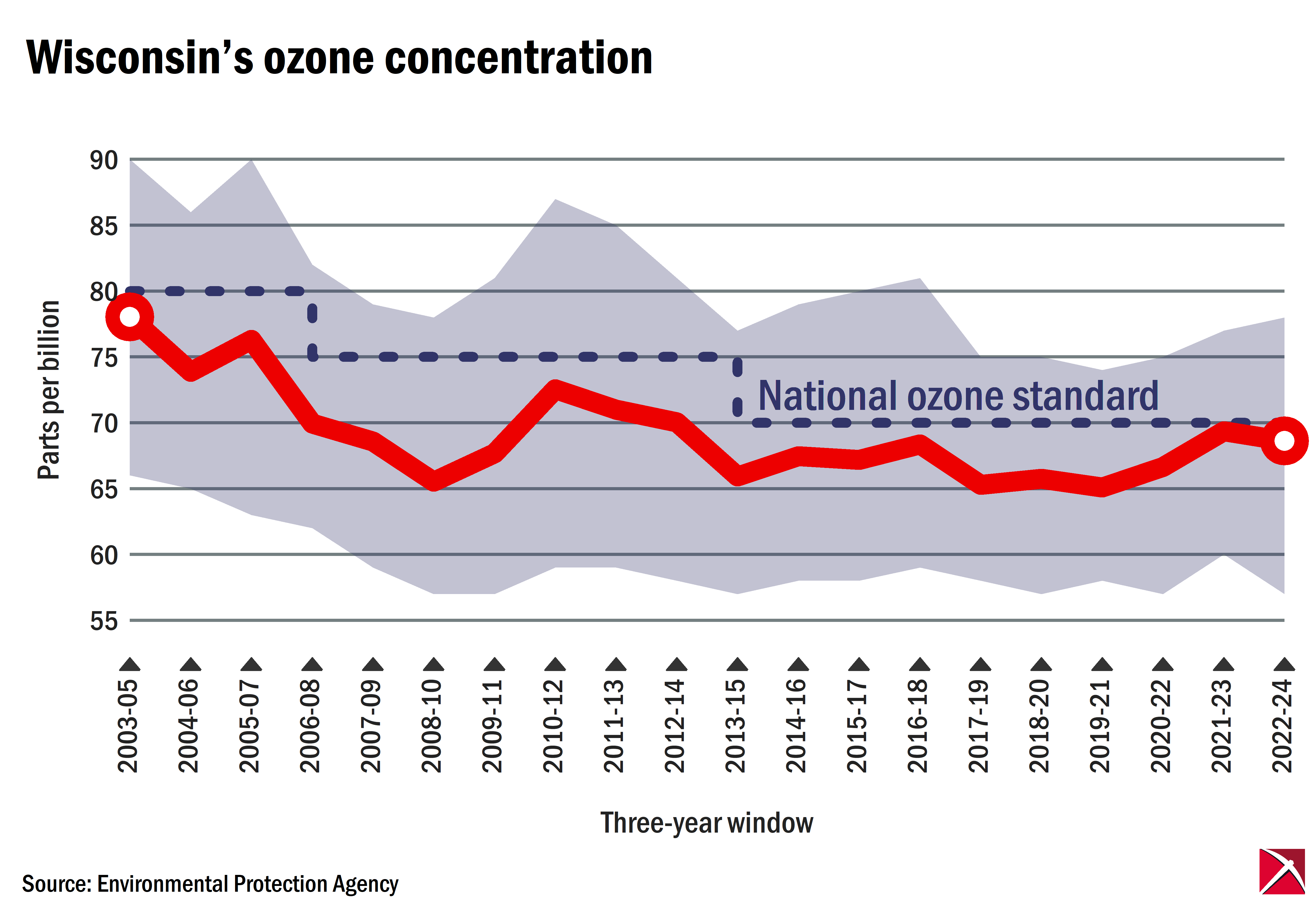
Ozone, an air pollutant, forms when nitrogen oxides and volatile organic compounds react in sunlight. Those chemicals, in turn, come from vehicles’ exhaust, industrial emissions and natural vegetation, among other sources.
The EPA measures ozone using what it calls a “design value” — the average of each year’s fourth-highest daily maximum 8-hour concentration reading, calculated over three years. Federal rules require that figure stay below 70 parts per billion (ppb).
For 2022–2024, Wisconsin’s monitoring sites averaged 68.6 ppb — below the threshold. Readings ranged from 57 ppb at the Bad River Tribe School site in Ashland to 78 ppb at sites in Kenosha and Sheboygan, both above the legal limit. While the Wisconsin Department of Natural Resources reports a statewide average of monitoring sites, regulatory enforcement is done on a county-by-county basis. Those elevated readings in eastern Wisconsin reflect a documented pattern, about which the Badger Institute has previously written: Prevailing winds carry ozone-forming pollution from northern Illinois and Indiana into southeastern Wisconsin, potentially exposing manufacturers in counties along Lake Michigan to penalties and added permitting requirements for pollution originating elsewhere.
Wyatt Eichholz is the Policy and Legislative Associate of the Badger Institute.
Any use or reproduction of Badger Institute articles or photographs requires prior written permission. To request permission to post articles on a website or print copies for distribution, contact Badger Institute Marketing Director Matt Erdman at matt@badgerinstitute.org.

