



By the numbers
In his latest round of pardons last week, Gov. Tony Evers, who already held the record for most pardons issued by any Wisconsin governor, issued batch of 220 more to bring the total over his tenure to 2,027.
Since the last Badger Institute report on the topic, Evers has now overtaken Heil as the most prolific issuer of pardons per year, reaching a rate of nearly 275 granted per year.

Evers’ issuance of pardons has exploded in the second half of his administration. Early in his first term, he issued pardons in small and more frequent batches. At the end of 2022, however, Evers abruptly changed course and began mass-issuing pardons a few times every year. In December 2022, Evers issued 171 pardons, bringing up his total to 774. Since July 2024, all of his pardons have been issued in batches of 150 or greater.
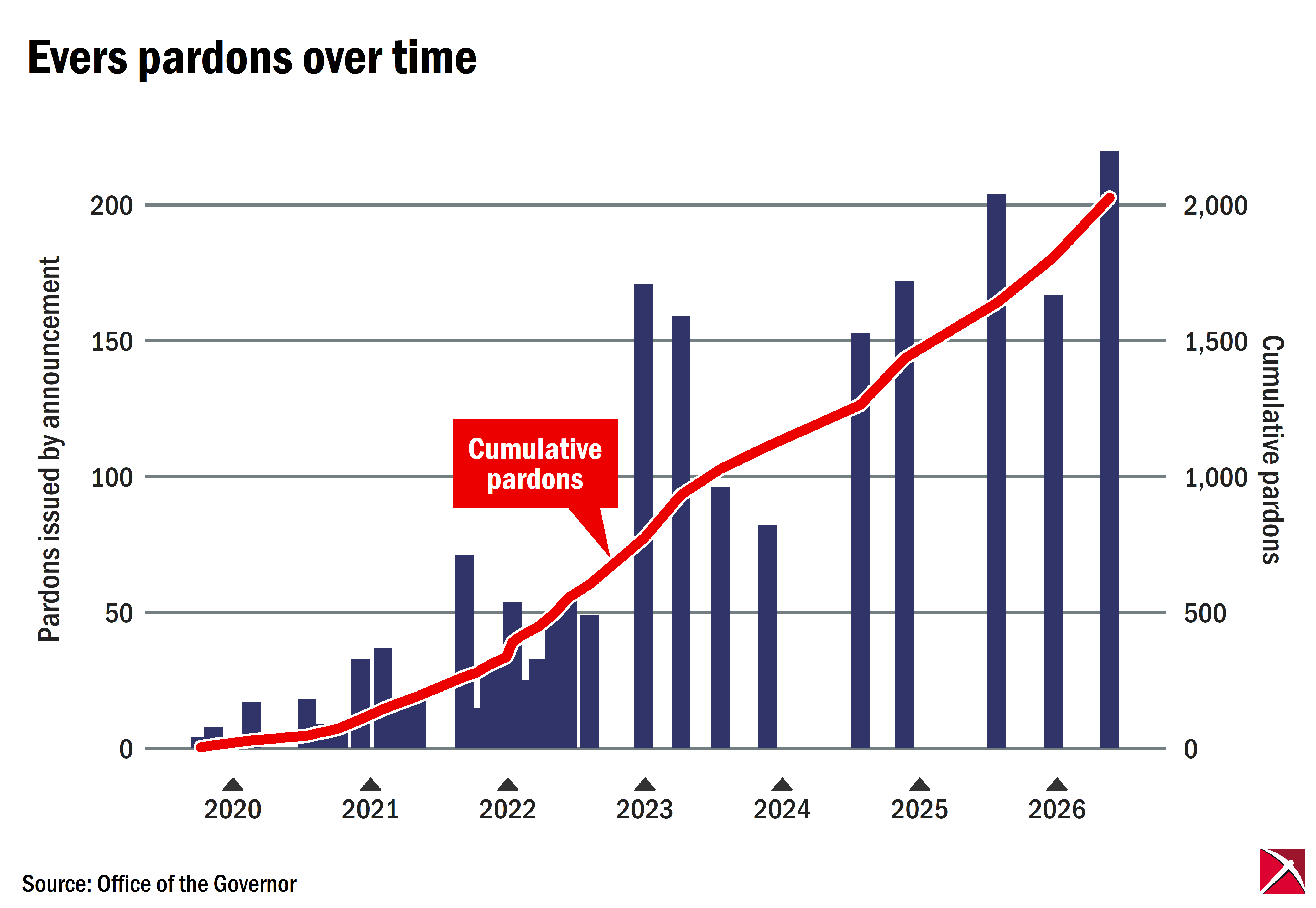
In the figure above, the left-hand axis shows the number of pardons issued per batch, graphed in the blue columns. The right-hand axis, which is on a 10-times larger scale, shows the cumulative pardons issued over Evers’ tenure, illustrated by the red line.
The Wisconsin constitution invests the power to grant clemency solely in the executive branch. Like the presidential pardon power under the U.S. Constitution, the Wisconsin governor has wide authority to pardon any person convicted for crimes against the State of Wisconsin at his discretion, as the Wisconsin Legislative Reference Bureau has outlined.
A pardoned criminal regains all civil rights, including the right to vote, the right to run for public office, and the right to possess a firearm. A governor may also issue a conditional pardon, which could be revoked if the person fails to fulfill certain conditions. Under current rules, Evers is issuing pardons only to criminals who already finished serving their sentences at least five years ago.

Each governor’s use of pardon power has varied widely. Following the example of some of his predecessors, Evers set up a pardon advisory board that processes applications and considers whether to grant pardons based on criteria that include the time since one’s sentence was completed and a person’s sex offender status.
Pardons aren’t the same as commutations, which cut short a criminal’s sentence — meaning early release for an inmate. Evers in April said he would start freeing inmates early via commutations. The previous three governors had commuted no sentences. None have yet been commuted, but this week, news outlet Wisconsin Right Now reported that at least 55 prison inmates from Milwaukee County — including 28 convicted killers — have informed the county’s district attorney they will seek commutations from Evers.
Wyatt Eichholz is a policy and legislative associate at the Badger Institute.
Any use or reproduction of Badger Institute articles or photographs requires prior written permission. To request permission to post articles on a website or print copies for distribution, contact Badger Institute Marketing Director Matt Erdman at matt@badgerinstitute.org.

